Land your first AI client in 90 days
Inside CC Strategic AI + you get my 27-day Claude Code mastery program with a 1-click install setup file, so you’re up and running on day one. Plus my GoHighLevel CLI, the Skool Automation MCP and Jarvis +. And you work WITH us to land your first AI client in 90 days, or your money back.
A four-person team rebuilt Adobe’s creative suite with Claude, open-sourced every version, and watched their repo jump from 10,000 to 100,000 GitHub stars in 6 days. The tool that made it possible is free, and you can use it today to reverse engineer an app with Claude Code.
Your clients are probably paying $1,000 to $2,000 a month for software that doesn’t talk to the rest of their stack. That’s $24,000 a year they rent and never own. I’m Charles J Dove, I run Charlie Automates, and this is the exact process I used to close a $40,000 deal with a construction company.
What Does the REA Repo Actually Do?
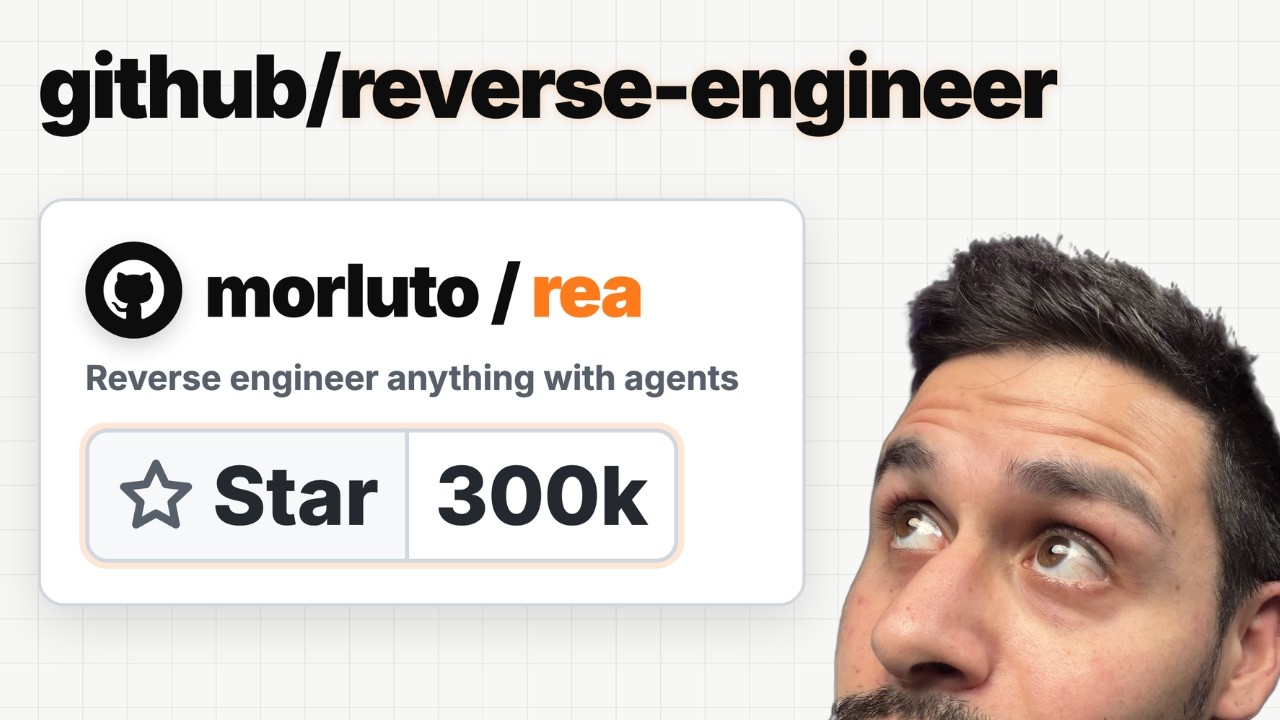
REA (Reverse Engineer Anything) is a free, open-source repo that plugs into Claude Code or Codex and lets your AI look under the hood of any piece of software. Think of a mechanic popping the hood on a car. You don’t just watch it drive, you see every part that makes it move.
You can point it at:
- Websites and web apps
- Android phone apps
- Desktop apps
- Even the raw file a computer runs
I’ve seen people take old printer drivers and rebuild them as brand new software with it. The point for you is simple. When you see a feature you love but can’t describe in words, REA analyzes how it works down to the binary level, and Claude uses that to build a version of your own.
Why Does Reverse Engineering an App Change Everything?
The old way cost tens of thousands of dollars. You paid a developer, and even then everyone guessed how your favorite app pulled off a feature. If you were locked into a vendor, you paid the subscription forever.
Now the math looks different. A Claude Code or Codex plan runs about $100 to $200 a month. You pick an app you pay for, REA shows Claude how it works, Claude builds it, and you own it. No more renting.
So the real question is why you’d keep paying for software that Claude Code can build for you.
How Do You Reverse Engineer an App With Claude Code in 5 Steps?
Here’s the flow I use:
- Install the repo inside Claude Code or Codex.
- Point it at the app you want to replicate.
- Let Claude map the full scope.
- Hand the scope to an orchestration tool. I use PAUL to plan and build.
- Show it to a business owner and book a call.
I demoed this on Duolingo. I used the /goal command inside Claude Code, Claude computer use, and the iPhone mirroring app so Claude could navigate my phone screen. I also had it spin up a couple of sub-agents to research how Duolingo works online.
Once Claude finished going through the app, I used SEED to put all the REA details into a new project folder. I asked it to prioritize a video call feature so a learner could chat with a tutor. Then it launched a PAUL project and moved it into my apps folder.
To build, I dragged the project folder in and ran /goal with plan, apply, unify, and loop until the project is done. Then I let it cook.
What Can the Finished App Do?
The app Claude built for me had a custom voice powered by Fish Audio, who sponsored this video. I handed Claude a Fish Audio API key and had it clone my voice from about 15 seconds of audio. The tutor character could switch moods (breathless and urgent, then excited and quirky) and even switch to Japanese. If you want voices inside your own builds, here’s my Fish Audio voice clone walkthrough.
What’s the Catch?
The catch is 30 years of edge cases. Big software companies spent three decades fixing weird problems you won’t see in week one of your build. Your version grows as real users find those problems.
So big software won’t disappear overnight. But a minimum viable product (MVP) has never been easier to build. You build version one with a clear definition of done, put it in front of the market, and see if you find product market fit.
How Do You Make Money Reverse Engineering Apps?
You don’t need a technical background. You need to diagnose a problem, then build the fix. Big software is built for millions of users, so nobody gets it their way, support is a ticket or a chatbot, and it rarely connects to the other tools a business runs on.
Here’s how I closed the $40,000 construction deal:
- One call to find their top problems: what’s slow, what’s costing money, what doesn’t talk to what.
- REA mapped the tool they were already paying for.
- Claude Code and PAUL built their own version, connected natively to everything.
- They own it. I host and manage it for a monthly fee.
You can charge $5,000 to $30,000 up front. If a client pays $2,000 a month, that’s $24,000 in a year and a quarter of a million dollars over a decade. Paying $30,000 once starts to look smart.
A simple version: two builds at $15,000 with a $500 monthly retainer is $30,000 up front and $1,000 a month in recurring revenue.
Who Should You Sell To?
Find someone already paying $1,000 or more for a tool that won’t connect to the rest of their stack. Construction, restoration, clinics and logistics companies are good fits. Target owners, chief operating officers and operations managers. Honestly, you can start with the business owner conversation before you build anything, to confirm product market fit before you do any tech work.
If you want to see another way to find those buyers, I wrote about how to pull leads with Claude and Apify.
Key Takeaways
- REA is free and open source. It plugs into Claude Code or Codex and analyzes any app down to the binary level.
- The 5 steps: install it, point it at an app, map the scope, build with PAUL, show a business owner.
- Own, don’t rent. A client paying $2,000 a month spends $24,000 a year on software they never own.
- Charge $5,000 to $30,000 up front, plus a monthly fee to host and manage.
- Expect edge cases. Version one won’t have 30 years of fixes, so sell it as an MVP.
- The money is in the relationship, not in being the next SaaS company.
Where to Go From Here
Land your first AI client in 90 days.
Join CC Strategic AI + for my 27-day Claude Code mastery program with a 1-click install setup file, and work WITH us to land your first AI client in 90 days, or your money back.
The tools from this walkthrough on charlieautomates.com:
At my agency CC Strategic we build systems like this for business owners, and new builds drop every week on my YouTube channel @charlieautomates.
FAQ
Can Claude Code reverse engineer an app? Yes. With the REA (Reverse Engineer Anything) repo plugged into Claude Code or Codex, Claude can analyze websites, web apps, Android apps, desktop apps and raw executables, then map how they work so you can build your own version.
Is REA free? Yes. It’s free and open source. You need a Claude Code or Codex subscription, which runs about $100 to $200 a month.
Will a rebuilt app match the original on day one? No. Big software companies spent 30 years fixing edge cases, and your version one won’t have them. Treat it as a minimum viable product and improve it as real users find problems.
How much can you charge to build a custom app for a client? I charge $5,000 to $30,000 up front, plus a monthly fee to host and manage it. Two builds at $15,000 with a $500 retainer comes to $30,000 up front and $1,000 a month recurring.
Do I need to know how to code? No. You need to diagnose a business problem and direct Claude Code. The build runs through an orchestration tool like PAUL.