Get your next client on autopilot
Inside AI Autopilot Academy you get my 27-day Claude Code mastery program with a 1-click install setup file, so you’re up and running on day one. Plus my GoHighLevel CLI, the Skool Automation MCP and Jarvis +. And you get a proven Claude Code content system to get your next client on autopilot.
Google “agentic OS” and you’ll find Slack, Make, a telecom company and a research paper all claiming the term. Most of them are describing enterprise software you’ll never buy.
Here’s the version that actually matters if you run a business. An agentic OS is the difference between asking AI a question and having AI do the job.
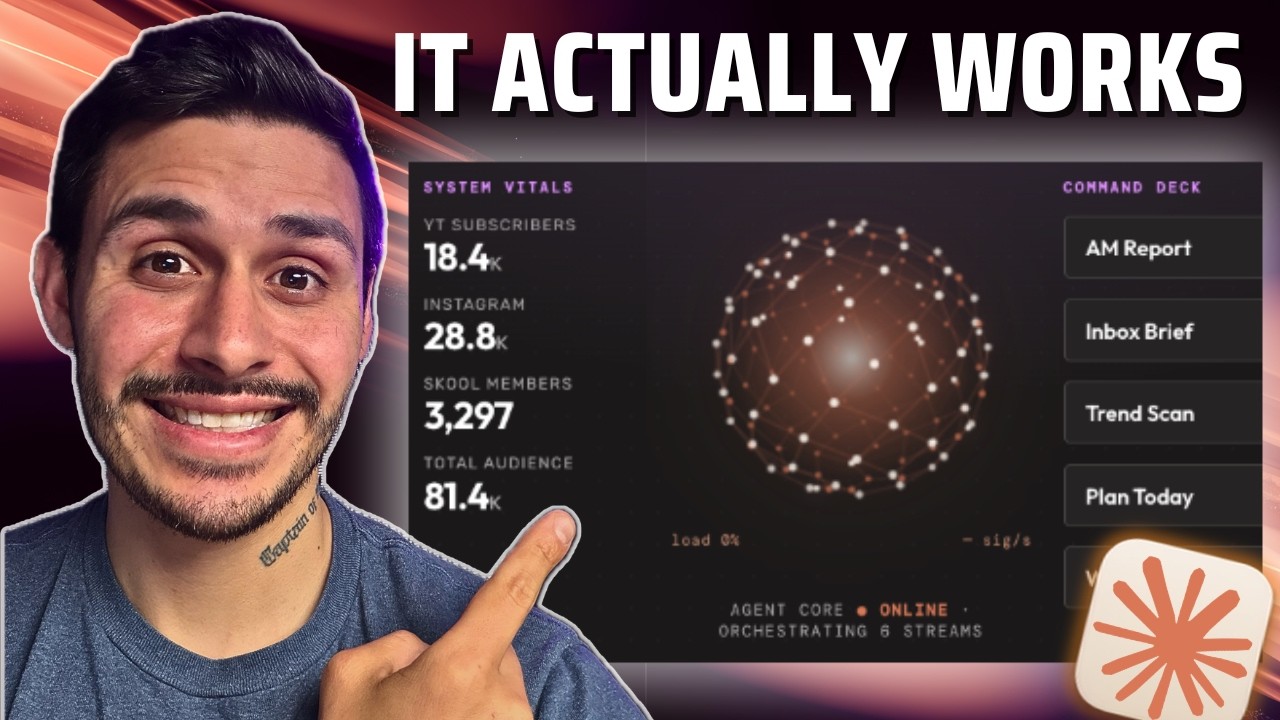
I’m Charles J Dove, I run Charlie Automates, and my whole business runs on one. Below is what an agentic OS is, the 7 parts every real one has, and the actual numbers from mine.
What Is an Agentic OS?
An agentic OS is the layer around an AI agent that gives it memory, rules, skills, tools and a place to run, so it can do real business work without you re-explaining everything every session. The agent is the worker. The agentic OS is everything that makes the worker useful on day 100, not just day 1.
Think about a new hire. A smart new hire with no onboarding, no access and no notes is useless for a month. An agentic OS is the onboarding, the logins, the playbook and the filing cabinet, built once, so your AI shows up trained every single morning.
In my setup the agent is Claude Code. The OS is what I built around it.
How Is an Agentic OS Different From a Chatbot or an Automation?
An agentic OS is different from a chatbot because it remembers and acts, and different from an automation because it handles work you never scripted. Here’s the side-by-side:
| Chatbot (ChatGPT, Claude.ai) | Automation (n8n, Zapier) | Single AI agent | Agentic OS | |
|---|---|---|---|---|
| Remembers your business | No, starts fresh | No | Within one session | Yes, every session |
| Follows your rules | Only if you paste them | Hard-coded | Sometimes | Loads the right rules automatically |
| Handles a task you never planned | Talks about it | No | Yes | Yes, with your tools and context |
| Uses your real accounts | No | Yes, fixed steps | Some | Yes, through MCPs and CLIs |
| Runs without you | No | Yes | No | Yes, on a server |
Automations are still great for fixed jobs. I run n8n workflows too. But an automation breaks the second the job changes. An agentic OS just reads the new situation and handles it.
What Are the 7 Parts of an Agentic OS?
Every agentic OS that actually works has the same 7 parts: a brain, rules, skills, tools, a build loop, an interface and a runtime. Here’s what each one does and what I run for it:
| Part | What it does | What I use | My numbers |
|---|---|---|---|
| 1. Brain | Remembers decisions, lessons and context | BASE knowledge graph, Graphify, Obsidian | 1,186 saved memories |
| 2. Rules | Tells the agent how you work | BASE domains that load only when relevant | 61 rule domains |
| 3. Skills | Repeatable jobs the agent does your way | Claude Code skills | 52 skills |
| 4. Tools | Access to your real accounts | MCP servers and CLIs | 18 MCP servers |
| 5. Build loop | Builds new tools without one-shotting them | SEED and PAUL | 28 active projects tracked |
| 6. Interface | How you talk to it | Terminal, dashboard, JARVIS voice | 3 ways in |
| 7. Runtime | Where it lives | My Mac, Hermes on a VPS, Railway | Runs 24/7 |
1. The brain is what makes it an OS
The brain is the part that makes an agentic OS worth building. Without memory, your AI is a goldfish with a PhD. My brain is BASE, a local CLI that hooks into Claude Code at session start, on every prompt and before every tool call. Nothing is remembered by the model. It’s recalled from the graph, so a lesson I logged in August still fires in November.
2. Rules keep it from repeating mistakes
Rules in an agentic OS are the instructions the agent follows without being told. I keep 61 rule domains, things like brand rules, email rules and coding rules, and only the ones that match what I’m doing load into the prompt. That keeps the context small and the output on-brand.
3. Skills turn one-off prompts into systems
Skills in an agentic OS are packaged jobs. When something works twice, it becomes a skill. My 52 skills cover things like making Instagram carousels in 15 minutes, invoices, comment replies and video edits. If you want to start small, here are the Claude Code skills worth installing first.
4. Tools give it hands
Tools are how an agentic OS touches your real business. I run 18 MCP servers. Two of them carry most of the weight: my GoHighLevel CLI with 253 tools for the CRM, and a Skool bridge with 90 tools for my communities.
What Does an Agentic OS Actually Do in a Day?
An agentic OS does the work you’d normally hand to an assistant, a junior marketer and an ops person. Three real runs from mine, all done by voice through my JARVIS assistant:
- Email triage. It read the last 24 hours across 2 inboxes, found 5 threads worth answering out of 48, created a task for one client issue and sent that client a reply.
- Pipeline review. It went through my GoHighLevel pipeline, found 47 real leads plus 8 test contacts, flagged 14 worth an email, and wrote me a note with 5 names to call today.
- Invoicing. It read a client’s email thread and built a branded invoice PDF with my invoice skill, without asking me a single question.
None of that is a chatbot answer. It’s work, done in my accounts, the way I’d do it.
Do You Need an Agentic OS?
You need an agentic OS if you do the same kinds of work every week and you’re tired of re-explaining your business to AI. You probably don’t need one if you open ChatGPT twice a week to rewrite an email.
The tell is simple. If you’ve ever pasted the same context into a new chat 3 times, you’re doing the OS’s job by hand.
How Do You Build an Agentic OS?
You build an agentic OS in 3 steps: give it a brain, let a build framework create your tools, then ship it somewhere it can run without you. I walked through every step, from a blank folder to a live app on my phone, in the 3-step system to build an agentic OS.
The short version:
- The brain. Obsidian plus Graphify, so Claude can search your data instead of rereading it.
- The build. SEED turns your idea into a spec, then PAUL plans, builds and tests it phase by phase.
- The ship. Keep it local, or push it to GitHub and Railway so it runs 24/7.
Pick your model last. The OS matters more than the model, but if you’re wondering, here’s how I split work between Fable 5.2 and Opus 5.5.
Key Takeaways
- An agentic OS is the layer around an AI agent: memory, rules, skills, tools and a place to run.
- Chatbots answer, automations repeat, an agentic OS does the work and adapts when the job changes.
- 7 parts: brain, rules, skills, tools, build loop, interface, runtime.
- Mine runs on Claude Code with 1,186 memories, 61 rule domains, 52 skills and 18 MCP servers.
- The brain is the part that matters most. Without memory it’s just a chatbot with extra steps.
- Build it in 3 steps: brain, build, ship.
Where to Go From Here
Get your next client on autopilot.
Join AI Autopilot Academy for my 27-day Claude Code mastery program with a 1-click install setup file, plus a proven Claude Code content system to get your next client on autopilot.
That 1-click install file sets up the same kind of agentic OS I run, so you start on day one with a brain, rules and skills instead of a blank terminal. At my agency CC Strategic we build these for business owners, and new builds drop every week on the Charlie Automates YouTube channel @charlieautomates. Free tools for every part live on charlieautomates.com.
FAQ
What is an agentic OS in simple terms? An agentic OS is the setup around an AI agent that gives it memory, rules, skills, tools and a place to run. It lets the AI do real work in your business every day without you re-explaining everything, the way an onboarded employee works compared to a new hire on day one.
Is an agentic OS an actual operating system like Windows? No. An agentic OS runs on top of your normal computer or a server. It’s called an operating system because it does for an AI agent what an OS does for apps: it manages memory, access to tools and where things run.
What is the difference between an AI agent and an agentic OS? An AI agent is the worker, like Claude Code. An agentic OS is everything around the worker: the memory, the rules, the skills, the tools and the runtime. The same agent gets far more useful inside a good agentic OS.
Can I build an agentic OS with Claude Code? Yes. Claude Code is the agent I build mine on. You add a brain with Obsidian and Graphify, build your tools with SEED and PAUL, and ship it locally or on Railway. The full walkthrough is in the 3-step agentic OS post on charlieautomates.com.