Not sure what to fix first?
Most people don’t need another AI tool. They need to know which thing is actually costing them the most.
The AI Bottleneck Finder asks you a handful of questions, then tells you the one constraint capping your revenue right now plus two builds you could ship this week. Five minutes, free, no call required.
Take the free AI Bottleneck Finder →
If you want to make real money with AI in 2026, prompting isn’t the skill.
I know that’s a bold statement. Everyone on social media is selling prompt packs. Courses on “10x your productivity with ChatGPT.” Templates for the perfect AI prompt.
But I’m going to tell you the truth. Prompting alone won’t get you paid. Systems will.
I’m Charles Dove, and I’ve spent the last 12 years building businesses. I run CC Strategic, an AI automation agency, and I create content on YouTube as Charlie Automates to help business owners and agency owners actually use AI to generate revenue. Not just play with it.
This post breaks down the exact mental framework I use before I build anything. No hype. No fluff. Just what works.
The Prompt Trap: Why Most People Stay Stuck
Most people start here. They write a prompt, hit run, and get an output. At first, it feels powerful. You get results fast. You feel productive.
But notice what’s actually happening.
Every run is manual. There’s no memory. Results change every time. And when something breaks, a human has to step in.
That’s why prompting feels good but never scales. Prompting creates activity, not leverage.
I see this all the time in my Skool community. Someone gets excited about a new AI tool. They run a prompt. They get a cool output. Then they share it in the group.
Great. But what happens tomorrow? They run it again. Manually. From scratch. With different results.
That’s not a business. That’s a hobby.
The Layer Nobody Talks About
Here’s the layer that most people don’t talk about. The questions that separate a prompt from a system:
- When does this run?
- What data goes in?
- What happens if it fails?
- Where does the output even go?
A prompt can’t answer these questions for you. And if these questions aren’t answered, you don’t have a system. You have a one-off trick.
This gap is why AI workflows collapse in the real world. Someone builds a cool demo. Posts it on Twitter. Gets likes. But the thing falls apart the second it touches real data with real edge cases.
I’ve seen it happen dozens of times. A business owner watches a tutorial, builds something in an afternoon, and then watches it break within a week. Because nobody taught them to think about the system around the prompt.
Prompt-First vs. System-First Thinking
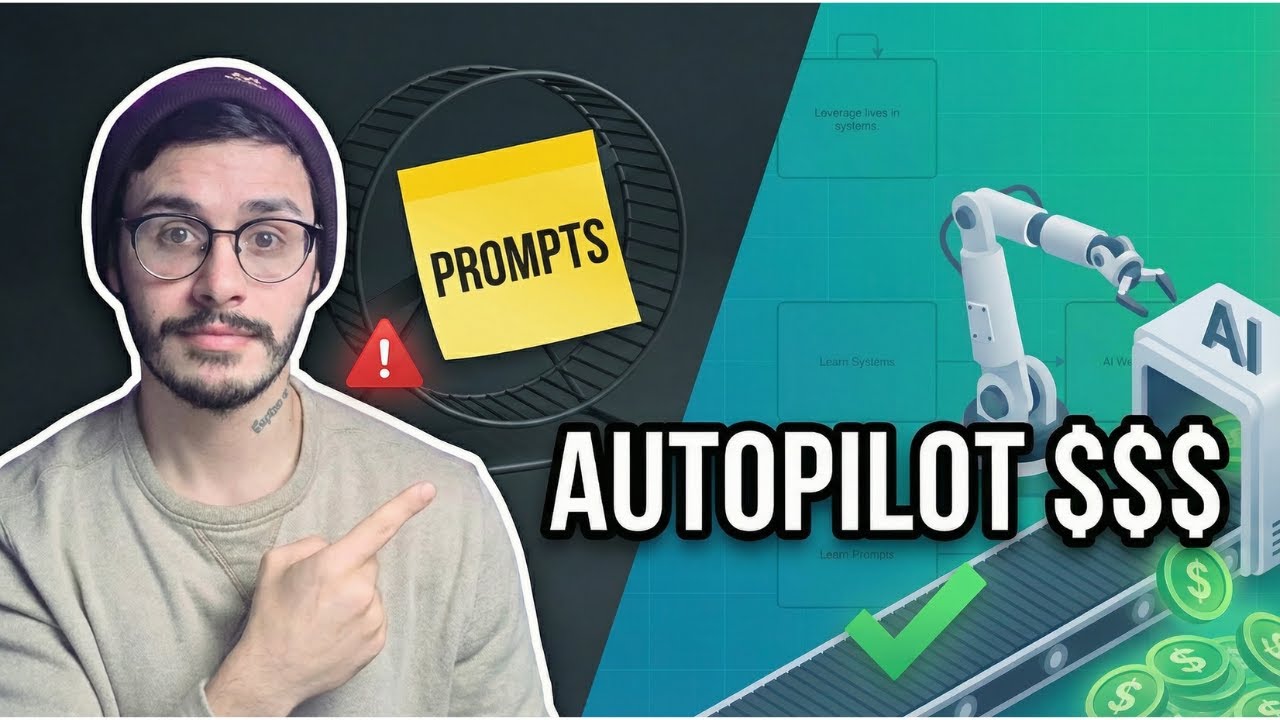
This is where everything changes. We’re going from prompt-first to system-first thinking.
Remember this: Prompts are inputs. Systems create leverage.
A system decides the trigger. It pulls the right data. It applies logic. Only then does it use a prompt.
Notice something important. The prompt is no longer the hero. It’s just one piece inside a bigger machine.
Here’s what that looks like in practice:
Prompt-first approach: You run it once. You get an output. You start over next time. Every interaction is isolated. There’s no learning. No memory. No fallback.
System-first approach: The system decides when to run. It pulls data from the right source. It applies rules and validation. Then, and only then, does it use a prompt. If validation fails, the system retries. If it succeeds, the output is stored, routed, or acted on.
Same prompt. Completely different outcomes.
That’s the power of putting systems first rather than just prompting first.
Why Systems Create Real Money
Let’s talk about money without hype.
Prompts are inputs. Systems are assets. Systems create predictable outcomes. That’s what creates the leverage, and ultimately, the money.
This is exactly why systems matter financially. You can create automated AI systems for:
- Autonomous research that runs while you sleep
- AI video pipelines that produce content on a schedule
- Content automation that publishes without you touching a button
- Business workflows that handle onboarding, follow-ups, and reporting
Every one of these automated AI systems runs without supervision, scales with demand, and delivers outcomes. Not simple text.
Here’s the bottom line. No business is going to pay you for prompts. They pay for results that keep on running.
The right AI system removes uncertainty. It delivers:
- Faster research which saves time
- Consistent content which builds trust
- Reduced labor costs which improves margins
- Reliable execution which prevents chaos
This is what businesses buy. Paid outcomes. They’re not buying intelligence. They’re not even buying AI. They’re buying predictability.
Money always follows systems. Simply because systems reduce risk, save time, and generate revenue.
The Prompt Comfort Zone (And Why You’re Stuck In It)
There’s a real reason most people stay stuck at prompting. I call it the prompt comfort zone.
Simple prompting feels fast. It gives instant feedback. It feels like progress.
On the flip side, systems feel slower. You have to think first. You’re not getting dopamine immediately.
So most people stop there.
But here’s the truth. Prompting alone doesn’t create leverage or any long-term value. I’ll admit it does feel productive. And yes, systems do feel boring.
But money lives in the boring.
That’s a line I come back to over and over again at Charlie Automates. The flashy stuff gets likes. The boring stuff gets paid.
How to Start Thinking in Systems Today
So how do we flip that switch? It’s simpler than you think.
Before I build any system, I consider: what is the lowest hanging fruit for my business, or for my client’s business? What type of system could I build that would either:
- A) Save them time
- B) Generate more revenue
- C) Both
Once I have a good idea of what that looks like, whether it’s prospect follow-ups, onboarding, research, or content automation, I ask four questions.
The Four System Questions
These four questions are the foundation of every system I build. Write them down.
1. What triggers the workflow?
Something has to start the process. A new lead comes in. A calendar event fires. A form gets submitted. A time interval passes. If you can’t name the trigger, you don’t have a system. You have a manual task dressed up as automation.
2. What data goes in?
Every system needs an input. Where does the data come from? A CRM? A spreadsheet? An API? A database? If you’re copy-pasting data into a prompt window, you’re doing the work the system should be doing.
3. What happens if the workflow fails?
This is the question that separates beginners from professionals. Real systems have error handling. If an API call fails, retry. If the data is malformed, log it and alert someone. If the AI returns garbage, catch it before it goes anywhere. Most people never think about this. And then they wonder why their “automation” broke after two days.
4. Where does the output actually go?
The output has to land somewhere useful. A Slack channel. A Google Sheet. A CRM field. An email. A database. If the output lives in a chat window that you close, you’ve wasted the work.
If you can answer those four questions, you’re already thinking in systems.
And here’s the best part. No tools yet. No automation yet. System thinking begins before software.
A Real Example: Prompt vs. System
Let me show you the difference with one example.
The Prompt Way
You open ChatGPT. You type: “Write me a follow-up email for a prospect who attended my webinar.” You get a decent email. You copy it. You paste it into Gmail. You send it.
Tomorrow? You do it again. For a different prospect. With slightly different context. Manually. Every single time.
The System Way
A webhook fires when someone registers for your webinar. Their info gets pulled from your CRM. The system checks: did they attend? Did they stay until the end? Did they click the offer link?
Based on those conditions, the system writes a personalized follow-up using AI. Then it sends it automatically. If the send fails, it retries. If it succeeds, it logs the activity back to the CRM.
You didn’t touch a thing.
Same AI. Same prompt underneath. But one creates a 5-minute task. The other creates a machine that runs forever.
The Decision in Front of You
This is the final decision in front of you.
You can stay comfortable and just learn prompts. And you’re basically just assisting AI. You’re the one doing all the work. AI just makes it a little faster.
Or you break down those barriers. You start to think the right way. You learn systems. And AI starts to work for you.
One path keeps you busy. The other creates leverage.
The thinking is the most important part. Not the tools. Not the software. Not the tech. You can watch a million videos to learn how to develop the workflows.
But if you can’t properly think and organize your thoughts to figure out a way to make somebody’s life easier, make them more money, or both, then you have no starting place to actually build anything meaningful.
So decide today. Not “can I learn it.” Not “will I learn it.” Say it: I will learn how to build systems today.
Frequently Asked Questions
Do I need to know how to code to build AI systems?
No. Tools like n8n, Make, and Zapier let you build systems visually. You drag and drop nodes, connect APIs, and set triggers. Coding helps, but it’s not required. What matters is the thinking behind the system, not the tool you use to build it.
What’s the difference between a prompt and a system?
A prompt is a single input that produces a single output. A system wraps that prompt in logic: triggers, data inputs, error handling, and output routing. The prompt is one small piece. The system is the machine that makes it useful at scale.
Where should I start if I’ve only been prompting so far?
Start with the four questions. Pick one repetitive task in your business. Ask: What triggers it? What data goes in? What if it fails? Where does the output go? Answer those and you’ve designed your first system before writing a single line of automation.
Can I sell AI systems to clients?
Absolutely. This is exactly what we do at CC Strategic. Businesses pay for outcomes, not prompts. If you can build a system that saves a client 10 hours a week or generates leads on autopilot, that’s worth thousands per month. The demand for this skill is massive right now.
What tools do you recommend for building AI systems?
I’m a big fan of n8n for workflow automation. It’s open source and incredibly flexible. For CRM and client management, GoHighLevel is solid. For chatbot automation, ManyChat handles DM flows well. But remember, the tool doesn’t matter as much as the system design behind it.
How long does it take to build a useful AI system?
Your first one might take a few days. But once you understand the pattern (trigger, data, logic, prompt, validation, output), you’ll start building them in hours. The framework stays the same. Only the specifics change.
Is prompting completely useless?
Not at all. Prompting is a necessary skill. But it’s table stakes. It’s the minimum. The people making real money with AI in 2026 aren’t the best prompt engineers. They’re the best system thinkers who happen to use prompts as one component.
Ready to Think in Systems?
If this shifted how you think about AI, here’s what I’d recommend:
Watch the full video to see the visual breakdown of prompt vs. system thinking. Sometimes seeing it laid out makes it click faster.
Join the community. I run a Skool group called CC Strategic AI where business owners and agency owners are learning to build real AI systems together. We do live calls, share workflows, and help each other level up.
Want it Done-For-You? Charlie OS is the DFY Claude Code setup with all my skills, plugins, and frameworks installed for you. Click the VIP option inside Skool to grab it.
The AI skill that pays in 2026 isn’t prompting. It’s thinking in systems. And the sooner you make that shift, the sooner AI starts working for you instead of the other way around.
You can grab the whole stack free in Free Resources, every skill and playbook I actually run.
Not sure what to fix first?
Most people don’t need another AI tool. They need to know which thing is actually costing them the most.
The AI Bottleneck Finder asks you a handful of questions, then tells you the one constraint capping your revenue right now plus two builds you could ship this week. Five minutes, free, no call required.