Not sure what to fix first?
Most people don’t need another AI tool. They need to know which thing is actually costing them the most.
The AI Bottleneck Finder asks you a handful of questions, then tells you the one constraint capping your revenue right now plus two builds you could ship this week. Five minutes, free, no call required.
Take the free AI Bottleneck Finder →
If you’re still building n8n workflows manually, watch this.
Full workflow connected. Ready to test. And I didn’t touch the canvas once.
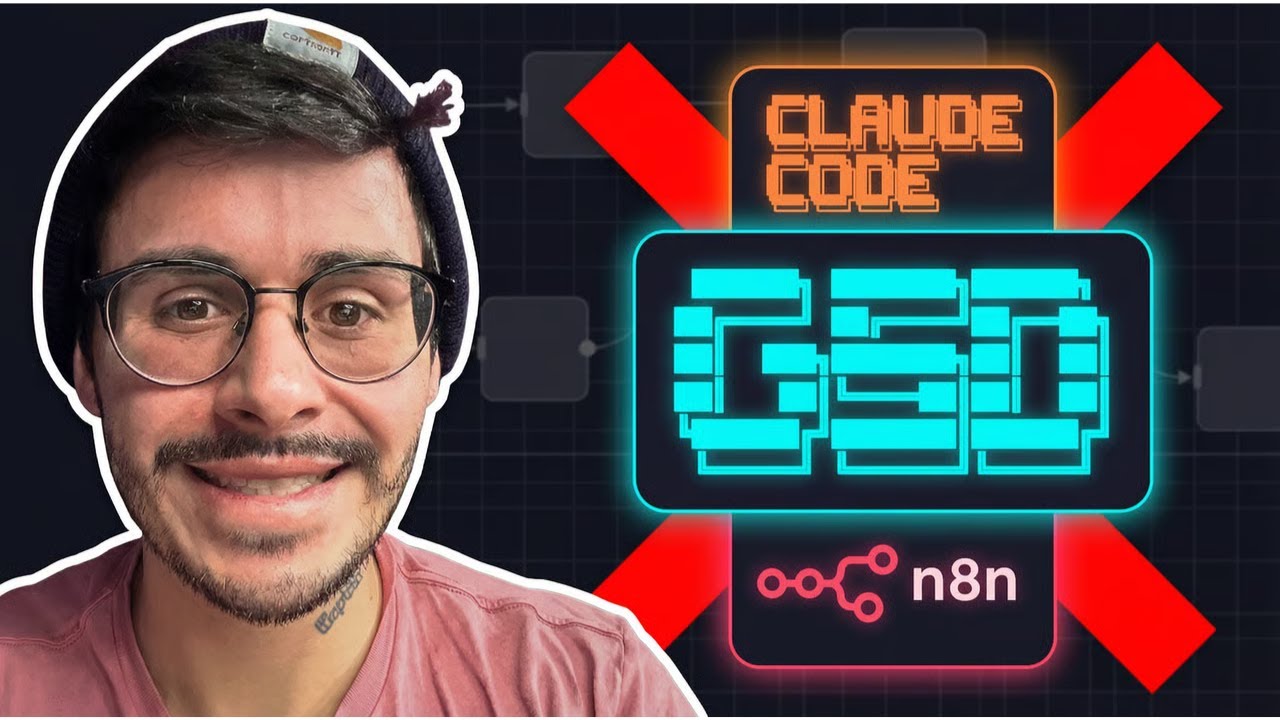
This is Claude Code, GSD, and the n8n MCP server. Three tools, one stack, and it’s about to change how you build automations.
The Stack That Changes Everything
I’m Charles Dove. I run CC Strategic, an AI automation agency, and I build in public over at Charlie Automates on YouTube.
In my previous videos, I showed you how to use GSD (Get Shit Done) with Claude Code to create apps and master UI design. But in this video, I’m going a step further. I’m showing you how to stack Claude Code, GSD, and the n8n MCP server to build workflows without ever building an n8n workflow manually again.
Let me break this down into three simple steps. First, I’ll show you the plugins. Second, I’ll show you how to use them. Third, we’ll go through a real example of how to use everything together.
Step 1: The Two Plugins You Need
GSD (Get Shit Done)
If you want more information on GSD, check out my other video on the Charlie Automates YouTube channel. It’s a tutorial on how to set it up. You’d just run a command in your terminal with Claude and it’ll install for you.
You can confirm GSD is installed when you type /gsd in Claude Code and you see the commands come up. Simple.
The n8n MCP Server
The second plugin is the n8n MCP server. Grab the link and ask Claude to install it for you. You’ll need to create an n8n API key and feed it into the server via Claude. That’s it.
To verify it’s connected, type /mcp in Claude Code and you should see the n8n MCP server listed. If you see that, you’re good.
One thing to know: I’m running n8n locally in Docker. Setting that up takes 5 to 10 minutes max. You can find guides on YouTube or inside my Skool community.
Step 2: How I Actually Use This Stack
The way I use Claude Code is more of a command center. I build apps in one workspace folder. Some people build different apps in different folders. Whatever your setup is, just let Claude know how you want GSD to build your projects. Ask it to update your CLAUDE.md file so it knows the structure.
If you don’t already have a CLAUDE.md file built, you can ask Claude to build one with you. That’s a whole fun process on its own.
My Workflow Process
Here’s my actual process. It’s very simple.
- Find a workflow I want to mimic. Sometimes I’ll screenshot a workflow from someone else and ask Claude, “Hey, can you give me a prompt to build a workflow like this?”
- Voice dictate the idea. I’ll speak it into existence. I describe what I need, ask it to create a prompt for Claude to build the workflow based off my specs.
- Feed it picture examples. After I’ve dictated, I’ll include screenshots to get the final prompt dialed in.
- Get a markdown code block. I always ask for a markdown code block that I can just copy and paste directly into Claude Code.
That’s the whole thing. Describe it, screenshot it, prompt it, paste it.
You Don’t Need GSD to Use the MCP Server
I do want to make this clear. You don’t need GSD to use the n8n MCP server to build workflows. You can ask Claude to build whatever workflows you need and it’ll build them automatically in n8n.
But GSD gives you something extra. It’s a more dynamic way to build your workflows when you’re creating multi-layer workflows that work in tandem and call upon one another.
For simple workflows? Just ask Claude to use the MCP server and build what you need. Then attach whatever APIs and accounts you need in n8n itself.
GSD becomes valuable when you’re building something bigger. When you need phases, project tracking, and context that carries across sessions.
Step 3: The Real Example, a Faceless YouTube Channel
Here’s where it gets fun. I wanted to create a flow of automations that would basically help me build a faceless YouTube automation channel.
Think about everything that involves: scraping viral ideas, compiling those ideas, generating scripts, creating voiceovers, producing video graphics, generating B-roll images. It’s a lot of moving parts.
Setting Up the Project with GSD
I used the GSD new project command. Claude reads my CLAUDE.md, sees the workspace structure, and asks me a few questions:
- Are you building an n8n workflow or an application? n8n workflow.
- What’s the workflow name? Faceless YouTube Automation Channel.
- What’s the niche? AI, tech, and automation.
- What tools are involved? Two LLMs, Gmail, Airtable.
- Interactive or YOLO mode? YOLO. Let it rip.
Notice it’s creating the project inside a workflows folder instead of the apps folder. I set that up in my CLAUDE.md so Claude knows the difference between project types.
What GSD Creates For You
GSD generated three key files:
- Project MD - An overview of what the project is and how it’ll be built
- Road Map MD - The phases and milestones for the entire build
- State MD - Tracks where you are on each individual workflow within the process
These markdown files give the project context. Whenever you start a new session, Claude reads them to understand where you left off. No more losing progress when the conversation compacts.
The Phase System
This is where GSD really earns its keep. When you’re building multi-layer workflows, you’d use the /clear command between phases. Claude gives you a separate command to either plan the next phase or execute it. The system pulls context from the markdown files without you having to explain everything again.
For a faceless YouTube channel, the phases break down all the individual workflows: the idea scraper, the organizer, the script generator, the voiceover system, the video packager. Each one gets planned and executed in order.
30 Minutes Later
After about 30 minutes of going back and forth with Claude, I had every workflow built. All of them. Let me walk through what it created.
The Viral Idea Scraper - Scrapes trending topics and content ideas from various sources in the AI and automation niche.
The Idea Organizer - Takes the scraped ideas, sorts them, and stores them in Airtable for easy access and prioritization.
The Script Generator - Pulls an idea from the organized list and generates a full video script optimized for YouTube.
The Voiceover Chunk Workflow - Takes the script and breaks it into chunks for text-to-speech generation.
The Video Generation Workflow - Assembles the final video from voiceover, graphics, and B-roll.
The Image B-Roll Generator - Creates supporting visuals and B-roll images to pair with the voiceover content.
Every single one of these was built automatically. Over 308 lines of prompt, and Claude handled all of it through the n8n MCP server.
What I Still Had to Do Manually
Here’s the honest part. The only thing I had to do manually was plug in all my accounts and connect everything so the workflows actually execute. API keys, Gmail credentials, Airtable tokens, LLM accounts.
Claude can build the entire workflow structure. It can connect the nodes, set up the logic, configure the flow. But it can’t log into your Gmail for you. That part is still on you.
But I didn’t have to think through and place all those nodes myself. I didn’t have to manually wire up the connections between steps. All the hard thinking was done for me.
Why This Stack Gets a 10 Out of 10
Building multi-layered workflows manually is a thing of the past.
I used to spend hours in the n8n canvas dragging nodes, connecting them, testing connections, fixing broken flows. Now I describe what I want, paste a prompt, and walk away.
For a project as involved as a faceless YouTube automation channel, which has six separate workflows that all feed into each other, the old way would’ve taken days. This took 30 minutes.
That’s not an exaggeration. Thirty minutes to go from idea to fully built workflow suite.
How to Get Started Today
Here’s the exact playbook:
- Install Claude Code if you haven’t already
- Install the n8n MCP server - Ask Claude to install it and feed it your n8n API key
- Install GSD - Optional but recommended for bigger projects
- Set up n8n locally - Docker is the easiest way, takes 5 to 10 minutes
- Start building - Describe what you need, paste the prompt, let Claude do the work
If you run into trouble with any of this, join my Skool community. I’ve got templates, resources, and a crew of people who are building the same way.
Want it Done-For-You? Charlie OS is the DFY Claude Code setup with all my skills, plugins, and frameworks installed for you. Click the VIP option inside Skool to grab it.
Tips for Getting Better Results
After using this stack on dozens of projects, here are a few things I’ve learned.
Voice dictation is your friend. Don’t type everything out. Speak your ideas into the prompt. It’s faster and you’ll describe the workflow more naturally.
Screenshot existing workflows. If you see a workflow you want to replicate, screenshot it and feed it to Claude. It’ll reverse-engineer the structure and build something similar.
Always ask for a markdown code block. This gives you a clean prompt you can copy and paste directly. No formatting issues.
Use YOLO mode for simple builds. If you know exactly what you want, skip the interactive questions and let Claude run with it.
Clear between phases. For big projects, use /clear between phases so Claude doesn’t lose context or burn through tokens trying to hold everything in memory.
The Bigger Picture
I’m not here to tell anyone what’s right or wrong. My goal with Charlie Automates is to open up your perspective on what’s possible with these tools.
Building n8n workflows by hand made sense when there was no other option. Now there is. Claude Code with the n8n MCP server can build whatever you describe. GSD adds project management on top so you don’t lose progress on bigger builds.
Three tools. One stack. Zero manual node dragging.
That’s the move.
FAQ
Do I need GSD to build n8n workflows with Claude Code?
No. You can use Claude Code with just the n8n MCP server to build any workflow. GSD adds project management features like phases, road maps, and state tracking. It’s most valuable when you’re building multi-layer workflows that require multiple sessions.
Does the n8n MCP server work with n8n Cloud or only self-hosted?
The n8n MCP server connects via API. I run n8n locally in Docker, which gives me full control. You just need an n8n instance with API access enabled and an API key to connect.
How long does it take to set up this entire stack?
About 15 to 20 minutes total. Installing Claude Code, the n8n MCP server, GSD, and n8n in Docker. Each piece is straightforward. If you get stuck, the CC Strategic AI Skool community has guides for every step.
Can Claude Code connect my API credentials in n8n?
No. Claude builds the workflow structure, the nodes, the connections, and the logic. But you still need to manually plug in your API keys, OAuth credentials, and account connections inside n8n. That’s the one manual step.
What types of workflows work best with this approach?
Everything from simple webhook-to-email flows to multi-layer automation systems. I’ve built lead capture workflows, content pipelines, CRM integrations, and the faceless YouTube channel example from this post. The more involved the workflow, the more time you save.
Is this approach good for someone who’s never used n8n before?
Yes, but I’d recommend understanding n8n basics first. Know what nodes are, what triggers do, and how workflows flow from left to right. Once you understand the concepts, letting Claude build the actual workflows is way faster than dragging nodes around yourself.
What happens when Claude’s server goes down mid-build?
It happens. When Claude’s server has a hiccup, you just pick up where you left off. If you’re using GSD, your progress is tracked in the state markdown file. Start a new session, Claude reads the state file, and continues building from where it stopped. That’s one of the biggest benefits of the phase system.
How much does this stack cost?
Claude Code requires an Anthropic subscription. n8n is open source and free to self-host. GSD is free and open source. Docker is free. The only ongoing cost is your Claude Code usage and whatever APIs your workflows connect to.
The N8N MCP server is free in Free Resources. Every skill and playbook behind this build lives there, along with the rest of the stack I run.
Not sure what to fix first?
Most people don’t need another AI tool. They need to know which thing is actually costing them the most.
The AI Bottleneck Finder asks you a handful of questions, then tells you the one constraint capping your revenue right now plus two builds you could ship this week. Five minutes, free, no call required.