Not sure what to fix first?
Most people don’t need another AI tool. They need to know which thing is actually costing them the most.
The AI Bottleneck Finder asks you a handful of questions, then tells you the one constraint capping your revenue right now plus two builds you could ship this week. Five minutes, free, no call required.
Take the free AI Bottleneck Finder →
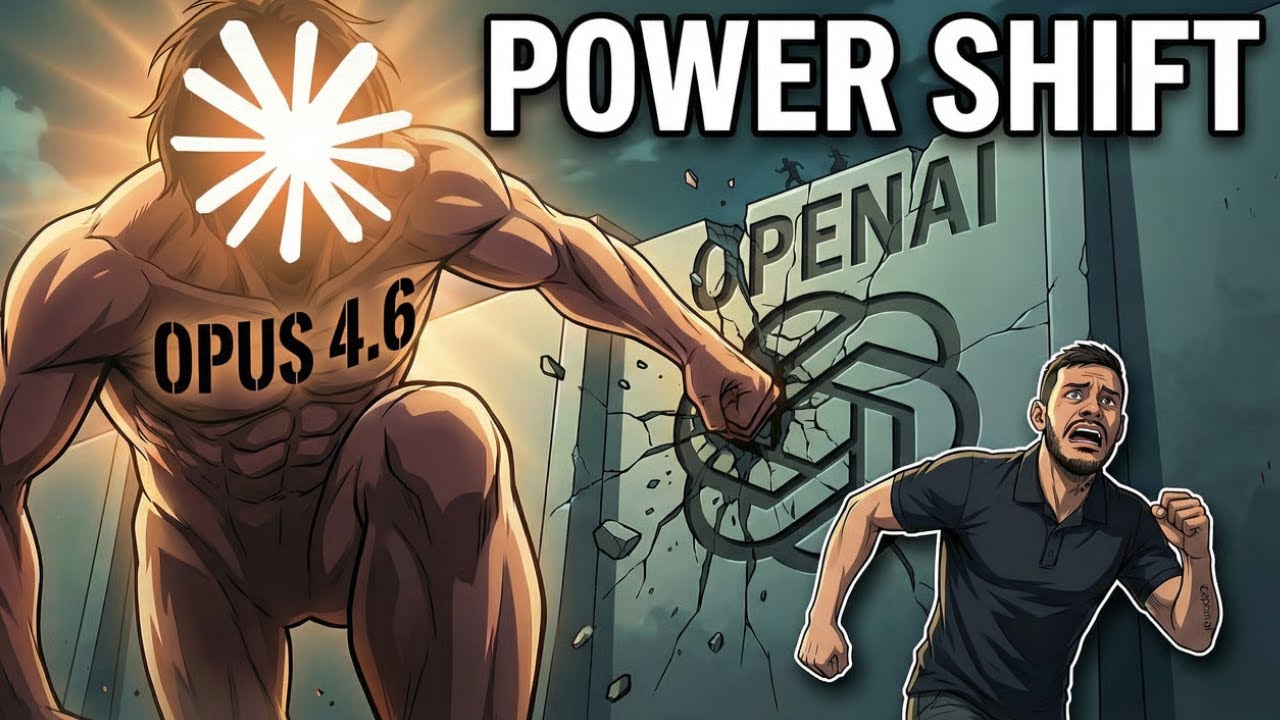
I’m calling it. Opus 4.6 is the beginning of the end for OpenAI.
That’s not clickbait. That’s what happens when one company ships real upgrades while the other runs a hype machine. Anthropic just dropped Opus 4.6, and I, Charles Dove, had to break it down for the Charlie Automates community immediately.
Let me walk you through everything that matters about this release. What’s new, what it means for your workflow, and why OpenAI needs to seriously rethink their strategy.
The Big Number: 1 Million Token Context Window
Let’s start with the headline feature. Opus 4.6 ships with a 1 million token context window in beta.
That’s five times what we’re used to. The standard was 200k tokens. Now Anthropic just handed us a million. Think about what that means for real work.
You can feed it entire codebases. You can load massive documents without worrying about hitting limits. You can run longer sessions without context rot destroying your output quality.
For anyone using Claude Code daily (like me), this is a game changer. I run parallel terminals, delegate tasks to sub agents, and build full projects inside the CLI. More context means fewer interruptions. Fewer times I have to clear context and start fresh.
Will I still clear context between phases? Probably. It’s still best practice. But the buffer is massive now. And the sub agents? They’re about to get way more powerful with this much room to work.
Benchmark Domination
Here’s the thing. Opus 4.6 isn’t just bigger. It’s better.
On the benchmark side, it’s outperforming OpenAI’s o1 5.2. It’s beating GPT-4.5. And it’s taking the lead on agentic terminal coding, which is exactly where I live every day.
Let me break down a specific number that caught my eye. On the needle-in-a-haystack benchmark (the 8 needle 1M variant), Opus 4.6 scored 76. Sonnet 4.5 scored just 18.5. That’s not a marginal improvement. That’s a completely different league.
This benchmark tests whether a model can find specific information buried in massive amounts of text. With a million token window, that matters more than ever. And Opus is crushing it.
The model is taking the lead on pretty much everything except graduate-level reasoning, where GPT still has a slight edge. But even there, the gap is so small it barely matters for practical work.
Adaptive Thinking and Effort Controls
Anthropic introduced two features that developers should pay attention to.
Adaptive thinking lets the model pick up on contextual clues about how much extended thinking to use. It’s smarter about when to think deeply and when to move fast.
Effort controls give you the ability to dial reasoning up or down. Running a quick conversational session? Set it to low. Tackling a complex debugging problem? Crank it up.
This is about token efficiency. Every AI company is trying to solve context rot. I really think Anthropic is going to be the one to take it where it needs to go.
The practical benefit? You save money on simple tasks. You get better output on hard tasks. And you don’t have to manage it manually because the model adapts on its own.
Compaction: Longer Sessions Without the Bloat
On the API side, Claude can now use compaction without bumping up against limits. This means longer coding sessions that don’t degrade in quality halfway through.
If you’ve ever had a Claude Code session start strong and then fall apart after an hour, you know the pain. Compaction helps the model manage its own context, keeping what matters and letting go of what doesn’t.
Combined with the million token window, this means your sessions can run longer and stay sharper. That’s the kind of upgrade that actually changes how you work.
Claude in Excel and PowerPoint
Anthropic also announced Claude integrations with Excel and PowerPoint. I’m not personally using these yet, but I immediately thought about tax season.
Last year I spent way too much time organizing financial statements for my accountant. With Claude in Excel, I could probably just feed it all my data and let it handle the formatting. We pay accountants too much and we pay the government too much. But that’s a different video.
The PowerPoint integration reminds me of NotebookLM. You feed it data, it builds presentations. If you don’t know about NotebookLM yet, check it out. It creates slideshows, podcasts, and study materials from your source content.
Why I Think OpenAI Is in Trouble
Let me be direct about this. I use all three major models. Each one has a purpose.
Opus/Claude Code is for actual work. Development, building, shipping. It’s pragmatic and logical. When I need something built right, this is where I go.
Gemini is for image and video generation. Nano banana, visual content, creative work. It’s very good at that specific job.
GPT I only use because I have my conversations and custom GPTs stored there. It’s set up already. But it’s not much better than the other models at anything. They can all do what GPT does.
The only area where I’d rank GPT above the others is creating prompts. But even that isn’t a reason to stay anymore.
Here’s what I see happening. OpenAI releases something, everybody gets excited, the hype cycle runs for a week. Then behind the scenes, Anthropic quietly drops a killer release that actually does what OpenAI promised but a million times better.
Sam Altman is running around doing interviews. Anthropic is shipping features. The ChatGPT app store was a big thing and it’s really nothing useful. The agent store? Same story.
OpenAI is riding a hype wave. They’re focusing so much on creating buzz around features that they’re not pushing the needle forward for developers and engineers.
I’m paying $100 a month for the Max times 5 plan with Claude. I love it. I don’t think I’ll ever leave unless Anthropic falls into an OpenAI situation. Once Claude Code levels up even more, I’m going to have to drop my GPT subscription entirely.
OpenAI would have to really up their game and do something different to get me to even consider keeping that subscription.
What This Means for You
If you’re building with AI right now, here’s my take.
Stop waiting for the next GPT release. The models that matter for development work are already here. Opus 4.6 with Claude Code gives you a million token context, agentic coding, and tool access including your browser.
Start learning Claude Code. It has access to all your tools, your Chrome browser, your file system. It doesn’t get any better than this for development work.
Think about your sub agents. With a million token context, you can delegate bigger tasks to sub agents. More context means more capability per agent instance. This opens up workflows that weren’t possible before.
Test everything yourself. I have to actually use this model before I give my full opinion. Benchmarks are great but real-world performance is what matters. We’re all going to have to test it, especially when it comes to fixing bugs and one-shotting projects.
The Model Comparison Reality Check
Let me strip away the hype and give you the honest breakdown.
| Feature | Opus 4.6 | GPT-4.5/o1 5.2 | Gemini |
|---|---|---|---|
| Context Window | 1M tokens | 128k tokens | 1M tokens |
| Agentic Coding | Leading | Behind | Not focused |
| Needle in Haystack (1M) | 76 | N/A | Competitive |
| Image/Video Generation | Not focused | Good | Best |
| Prompt Creation | Good | Slightly better | Good |
| Developer Tools | Claude Code, API | ChatGPT, API | AI Studio, API |
The numbers speak for themselves. For anyone doing serious development work, Opus 4.6 is the clear winner right now.
My Prediction Going Forward
Gemini is going to release some fire models soon. Google has the resources and the talent. But right now, Anthropic owns the developer workflow.
The AI race isn’t about who has the best chatbot anymore. It’s about who builds the best tools for people who actually ship products. And Anthropic is winning that race.
Every model is getting more concise. Every company is trying to solve context rot. But Anthropic is the one actually delivering on the promises that matter to builders.
4.6 is a better model than 4.5. I’ll probably complain less about it. But I’m sure we’ll still run into some issues with bug fixes. That’s just the nature of new releases.
The bottom line? We’re in the future of the future. And if you’re not paying attention to what Anthropic is doing, you’re going to get left behind.
Frequently Asked Questions
What is Claude Opus 4.6?
Claude Opus 4.6 is the latest model release from Anthropic. It features a 1 million token context window (up from 200k), adaptive thinking, effort controls, and improved benchmark performance across coding and reasoning tasks.
How big is the Opus 4.6 context window?
Opus 4.6 has a 1 million token context window in beta. That’s five times larger than the previous 200k token standard. This means you can load entire codebases, long documents, and run extended sessions without hitting context limits.
Is Opus 4.6 better than GPT-4.5?
On most benchmarks, yes. Opus 4.6 outperforms GPT-4.5 and OpenAI’s o1 5.2 on agentic terminal coding, needle-in-haystack retrieval, and several other metrics. GPT still has a slight edge in prompt creation and graduate-level reasoning, but the gaps are small.
What is adaptive thinking in Opus 4.6?
Adaptive thinking lets the model automatically adjust how much extended reasoning it uses based on the complexity of your request. Simple questions get quick answers. Complex problems get deeper analysis. This saves tokens on easy tasks and improves quality on hard ones.
What are effort controls in Opus 4.6?
Effort controls let developers manually set how much thinking the model should do. You can set it to low for quick conversational tasks or high for complex reasoning and debugging. This gives you more control over token costs and response quality.
Should I switch from ChatGPT to Claude?
It depends on what you’re doing. For development work and coding, Claude with Opus 4.6 is the stronger choice right now. For image generation, Gemini is still the best. For casual use with existing custom GPTs, ChatGPT is fine. But the gap is closing fast.
How much does Claude Code cost?
The Max times 5 plan runs $100 per month. For heavy development use, it’s worth every penny. The standard pro plan is $20 per month. Check Anthropic’s pricing page for the latest options.
What is compaction in Claude?
Compaction is a feature that helps the model manage its context more efficiently during long sessions. It keeps important information and drops what’s no longer relevant, preventing the quality degradation that happens in extended conversations.
Want to go deeper on Claude Code and AI development? I break down tools, workflows, and real builds on my YouTube channel @charlieautomates. No fluff. Just what works.
Ready to level up? Here’s how I can help:
- Join CC Strategic AI on Skool for Claude Code templates, n8n workflows, and a community of builders shipping real products
Every skill, plugin, and playbook I use is free in Free Resources. That is where the builds in this post come from.
Not sure what to fix first?
Most people don’t need another AI tool. They need to know which thing is actually costing them the most.
The AI Bottleneck Finder asks you a handful of questions, then tells you the one constraint capping your revenue right now plus two builds you could ship this week. Five minutes, free, no call required.